Monday, 13 June 2016

Acura NSX supercar 2017


Acura will field a pair of 2017 Acura NSX supercars in the 100th Anniversary of the running of the Broadmoor Pikes Peak International Hill Climb on June 26, marking the North American racing debut of Acura's next-generation NSX: the pinnacle expression of Acura Precision Crafted Performance and the only supercar made in America.


The two Acura NSX supercars will compete in the Time Attack 1 and 2 classes and will be piloted by brothers James and Nick Robinson, respectively, both from the company's North American engineering team. In addition, Acura will campaign an NSX-inspired prototype vehicle in the Electric Modified Class, featuring a further evolution of the experimental all-electric, 4-motor Super Handling All-Wheel Drive (SH-AWD) powertrain that won last year's Pikes Peak Challenge Exhibition class.
"Pikes Peak is like no other race in the world and offers a unique opportunity to showcase the power and performance of our products," said Jon Ikeda, vice president and general manager of the Acura Division. "We are excited for this year's 'Race to the Clouds' to test the endurance and engineering of the Acura NSX and our advanced powertrain technologies – as well as an expression of our racing spirit."


A team of North American R&D engineers has been working on both NSX entries, which feature the same three-motor Sport Hybrid Super-Handling All-Wheel Drive powertrain (Sport Hybrid SH-AWD) as the production NSX. This powertrain features a twin-turbo V6 engine mated to a 9-speed dual clutch transmission and Rear Direct Drive Motor, and a front Twin Motor Unit with a world's first electrically powered torque vectoring capability in the supercar realm. Modifications to the NSX competing in the Time Attack 1 class included chassis lightening and a custom high-flow racing exhaust.


The NSX competing in the Time Attack 2 class is a production car with the required safety equipment for competition. The Time Attack 1 NSX will be driven by James Robinson of the company's North American powertrain development group, who drove a first-generation NSX in the Pikes Peak Hill Climb from 2012 to 2015. His brother Nick Robinson, an engineer in charge of the new NSX's dynamic performance during its development, will drive the Time Attack 2 NSX. Nick is also the reigning PP250 winner from the 2015 Pikes Peak Hill Climb.

The supercar-inspired 4-Motor EV Concept will be driven by Tetsuya Yamano, who campaigned last year's CR-Z-based electric prototype. The EV Concept is the ultimate embodiment of the all-wheel-drive Electric SH-AWD powertrain featuring a world's first technology that enables four-wheel independent torque allocation. The Electric SH-AWD powertrain, an evolution of the CR-Z prototype powertrain, produces three times the total system output of last year's electric prototype and is mated to the NSX body.

As Official Pace Car sponsor, Acura will feature three pace cars – the NSX, the seven-passenger MDX performance-luxury SUV and the TLX sports sedan. President of Polyphony Digital and Producer of the Gran Turismo series Kazunori Yamauchi and Pikes Peak legends Randy Schranz and Leonard Vahsholtz will lead the field of 100 entrants to the top of the 14,115-foot Colorado peak.

For Pikes Peak race attendees, the NSX and other pace cars will appear at a number of pre-race activities, including the popular Fan Fest in downtown Colorado Springs, 5 to 10 p.m. MDT Friday, June 24.

Friday, 13 May 2016

Next generation Amorphous Silicon (SiO) Li-ion Battery

Nissan Motor Co., Ltd. and Nissan Arc Ltd. announced today joint development of an atomic analysis methodology that will aid in boosting the performance of lithium-ion batteries, and ultimately extend the driving range of zero-emission electric vehicles.

The breakthrough was the result of a combined R&D effort between Nissan Arc Ltd., a Nissan subsidiary, Tohoku University, the National Institute for Materials Science (NIMS), the Japan Synchrotron Radiation Research Institute (JASRI), and Japan Science and Technology Agency (JST).
The analysis examines the structure of amorphous silicon monoxide (SiO), widely seen as key to boosting next-generation lithium-ion battery (Li-ion) capacity, allowing researchers to better understand electrode structure during charging cycles.

Silicon (Si) is capable of holding greater amounts of lithium, compared with common carbon-based materials, but in crystalline form possesses a structure that deteriorates during charging cycles, ultimately impacting performance. However, amorphous SiO is resistant to such deterioration.
Its base structure had been unknown, making it difficult for mass production. However, the new methodology provides an accurate understanding of the amorphous structure of SiO, based on a combination of structural analyses and computer simulations.

The atomic structure of SiO was thought to be inhomogeneous, making its precise atomic arrangements the subject of debate. The new findings show that its structure allows the storage of a larger number of Li ions, in turn leading to better battery performance.

“The invention of this new analysis method is essential to further develop the next generation of high-capacity lithium-ion batteries. It will certainly become one of our core technologies. The utilization of this analysis method in our future R&D will surely contribute to extending the cruising range of future zero-emission vehicles,” said Takao Asami, senior vice president of Nissan Motor Co., Ltd. and President of Nissan Arc Ltd.

Daniele Schillaci, executive vice president of Nissan Motor Co., Ltd., Global Sales & Marketing including Zero Emission Vehicle and Battery business, said the development was another proof point of Nissan’s commitment to innovation in advanced technologies.
“Nissan is exploring a wide range of energy sources for tomorrow’s vehicles, and we recognize our role in continuously investing in multiple technologies and intelligent mobility,” said Schillaci.

Thursday, 28 April 2016

To develop EV Battery- "Ford, Xerox PARC and Oak Ridge" Team up

Xerox PARC today announced its ‘Co-Extrusion (CoEx) for Cost Reduction of Advanced High-Energy-and-Power Battery Electrode Manufacturing’ project funded by the U.S. Department of Energy’s (DOE) Office of Energy Efficiency and Renewable Energy (EERE). In collaboration with Oak Ridge National Laboratory (ORNL) and Ford Motor Company, the project will use PARC’s novel CoEx printing technology to fabricate thick higher energy and higher power battery electrodes with the end goal of enabling longer range and low cost electric vehicles.

The project goal is to demonstrate pilot-scale, electric vehicle (EV) pouch cells with a 20% improvement in gravimetric energy density (Wh/kg), and a 30% reduction in $/kWh costs. CoEx allows fine structures to be printed at high speed, and when applied to thick battery electrodes, it adds a new design dimension that can be used to enhance energy and power performance. This innovative approach has the potential to help make high performance and affordable electric vehicles (EVs) a reality.PARC will develop the inks and CoEx hardware required to fabricate a thick high energy and high power CoEx cathode electrodes. ORNL will assist PARC with the matching anode development, anode and CoEx cathode coating at pilot scale, and electrochemical performance optimization in automotive-relevant lithium-ion pouch cells. The bulk of this research will occur at the DOE Battery Manufacturing R&D Facility (BMF) at ORNL, which was designed in 2011 with these types of projects in mind. PARC will design a custom CoEx apparatus that will be integrated into one of the research coating lines at the BMF.

“The PARC team is excited to start this collaboration with ORNL and Ford. CoEx has the potential to make higher capacity EV batteries possible through the creation of two and three dimensional structures which can enhance lithium-ion pathways in ultra-thick battery electrodes. Our goal is to fabricate EV pouch cells that are higher in energy and power than conventional, with a path towards a reduction in $/kWh costs for EVs”said project principal investigator and PARC CoEx technical lead Dr. Corie Cobb.

“PARC and ORNL have a track record of working successfully together, and their collaboration on this project will transform the way lithium-ion electrode coatings are made and perform under high discharge rates,” said ORNL project lead David Wood.

PARC’s CoEx project is part of a portfolio of research within the PARC Energy Technology Program aimed at developing practical solutions to make clean and abundant energy available across a wide range of applications. This includes a focus on improving energy storage for EVs, consumer electronics, and electric grid support through better ways to make, monitor, and manage batteries.“By leveraging our deep background in printing, PARC has developed the CoEx printing process to enable higher performance solar cells, fuel cells and batteries.,” said Scott Elrod, Vice President of PARC’s Hardware Systems Lab. “By applying CoEx to printed batteries, we can create optimal structures that boost power performance without compromising energy storage. It’s an efficient and a lower-cost approach that can be applied to the mass manufacturing of batteries.”

Thursday, 12 November 2015

BMW eRR Electric Super Bike

The BMW Mottorrad Group announced the "experimental vehicle eRR" electric super sport motorcycle.


Press Release:-

Munich. BMW Motorrad has a long tradition in pointing out new ways and thoughts for the topic "mobility on two wheels“. For that, again and again many studies were presented in the past giving views to the future. The experimental vehicle eRR, created as a project with the Technical University of Munich, embodies an idea of an electric powered supersport motorcycle made by BMW Motorrad.
Already a couple of years ago, BMW i showed the BMW Group’s visionary and sustainable approach with the vehicles BMW i3 and i8 and their revolutionary design principles (aluminum chassis and passenger cabin made from carbon fibre) and BMW Motorrad’s C evolution proved, that zero emission, riding fun and practicability do not exclude themselves.
With presenting the experimental vehicle eRR BMW Motorrad goes one step forward and shows the possibilities of an all-electric drive in a supersport motorcycle. Regarding design and chassis technology the eRR leans on the supersport motorcycle S 1000 RR, however using an all-electric drive.
Stephan Schaller, Head of BMW Motorrad, emphasizes: „Since their market launch, the RR is giving the creeps to motorsport athletes. If acceleration, handling or topspeed – the RR is setting standards. However, if acceleration on the first metres, up to 50, 60 kph, is the point, the RR’s 199 bhp have to admit defeat by another BMW product: the C evolution with its electric drive.
We asked ourselves: What happens when combining a sport motorcycle and an electric drive? The experimental vehicle eRR brings the topic zero emission and electric drive on a new, more fascinating level.”
BMW Motorrad will announce technical details of the eRR at a later date.


Monday, 2 November 2015

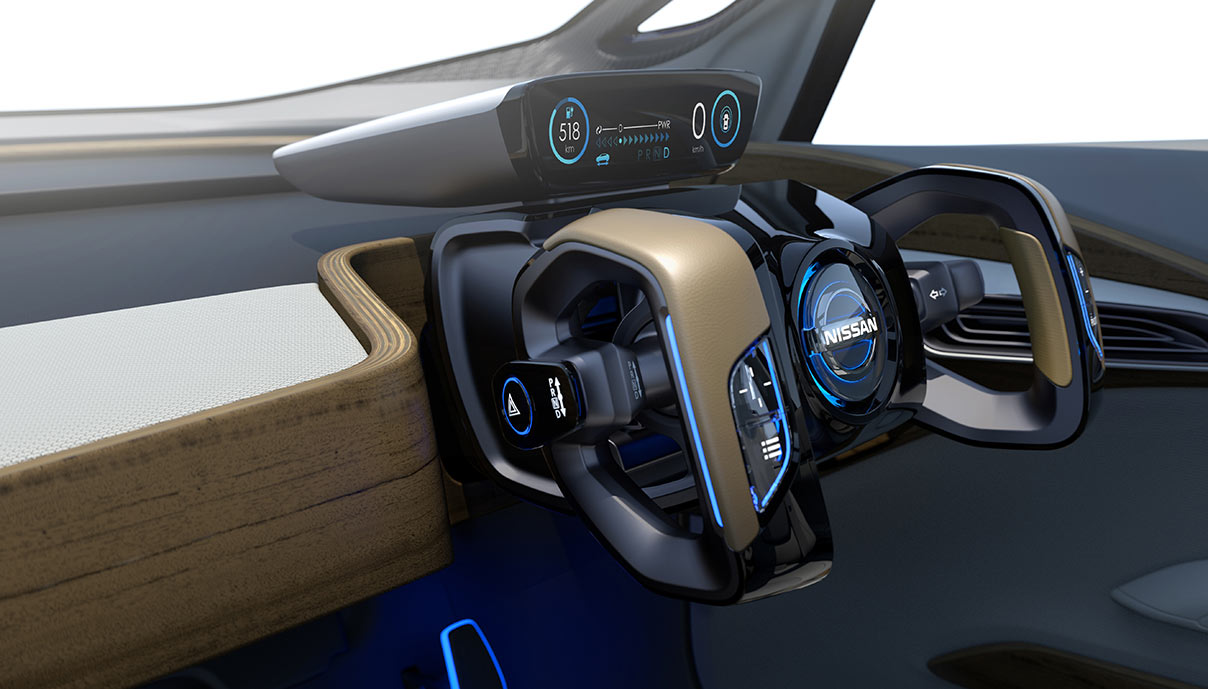
Nissan 'IDS Concept' Electric Car

A vision of autonomous driving in future: Nissan IDS Concept


At the Tokyo Motor Show 2015, Nissan Motor Co. Ltd. unveiled a concept vehicle with autonomous driving and zero emission. Presenting at the show , Nissan president and CEO Carlos Ghosn said: "Nissan's forthcoming technologies will revolutionize the relationship between car and driver, and future mobility."

The sleek automobile comes in two modes: Manual and Piloted

Vehicles one with fully capable of autonomous driving would be on sale by 2020. The IDS is an conceptual vehicle but its 60 kWh is still conceptual. The IDS Concept previews key engineering and design technology to be incorporated on future Nissan vehicles. This includes carbon-fiber construction, and a compact aerodynamic shape with fin like vertical fenders front and rear.

It has 2 stages of autonomous driving, which mirrors Nissan's plans to introduce this technology. The company plans to introduce a degree of autonomous driving it calls Piloted Drive by 2016; technology that can maintain station in a single lane by itself. That system could then be upgraded into merging motorway and changing lane by itself.


"Nissan Intelligent Driving improves a driver's ability to see, think and react," Ghosen said, "It compensates for human error, which causes more than 90% of all car accidents. As a result, tme spent behind the wheel is safer, cleaner and more efficient."